
By Mike Smith
Three of the most important handbooks in my collectibles library were all authored by a passionate collector who inspired me to develop my own handbooks. This soft-spoken author and true gentleman was Dorval, Quebec’s Wally Gutzman (1920–2010). His first labour of love, The Canadian Patriotic Post Card Handbook 1904–1914, was published by The Unitrade Press, Toronto in 1985. For me, this handbook was an absolute godsend. You see, the beauty of Canada’s early patriotic postcards was the reason I was lured into postcard collecting in the first place. And until Gutzman rolled up his sleeves, there was an appalling lack of information for Canadian collectors when I got into the hobby in 1981.
Gutzman’s next two handbooks, The Canadian Picture Post Card Catalogue 1988 and its second edition in 1992 had, among other things, sections devoted to Canadian postcards with colourful pictorial advertising. Some of this advertising was printed on early Canadian postal stationery, which were cards issued by the post office with imprinted stamps (see Figure 1). And some can be found on early Canadian private postcards. These would be cards the private sector was allowed to publish beginning on New Year’s Day 1895. In this Wayback Times article then, I’m going to showcase some of the cards with pictorial advertising that caught my eye while helping Jack de la Vergne with the second edition of his lavishly-illustrated Graphic Art & Design on Advertising Postcards.
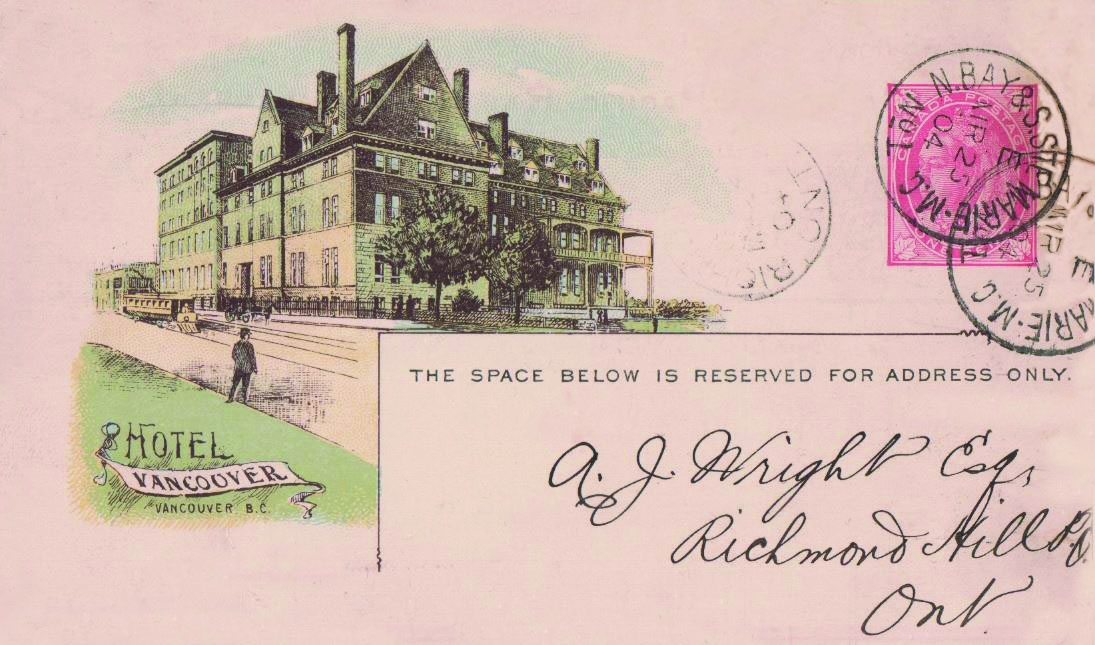
Figure 1. An early version of the Canadian Pacific Railway’s Hotel Vancouver is shown on this attractive postal stationery card mailed in 1904.
Another of the wonderful advertising cards earmarked for the second edition of de la Vergne’s book is shown as Figure 2. Published by Toronto’s Canada Biscuit Co. when no messages were allowed on a card’s stamp side (i.e., the undivided-back era), this pre-1904 card is collectible on multiple levels. Patriotic postcard enthusiasts would definitely love the prominent maple leaf under the stamp. And if you look closely at the left side of the colourful biscuit tin, there are several more patriotic features – maple leaves, a moose and a Canada crest. Of course, those who collect advertising postcards and vintage tins would find this card hard to resist.
For the record, according to Google the Canada Biscuit Co. was not affiliated with Toronto’s more famous industrial baker – Christie, Brown and Co. Nevertheless, both companies are known to collectors for their colourful advertising on postcards, other print media, and biscuit tins.
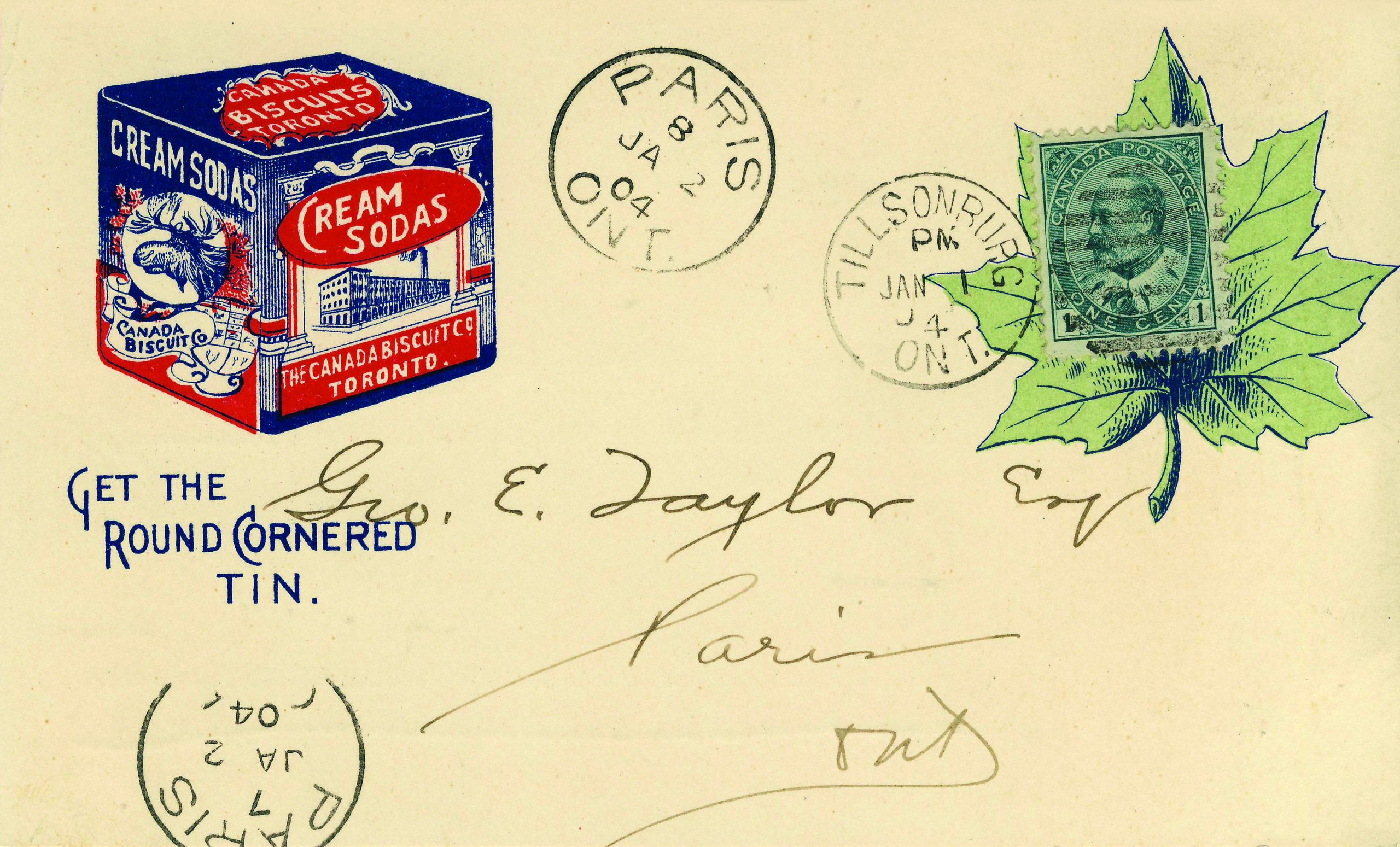
Figure 2. This circa 1903 colourful advertising postcard was published by Toronto’s Canada Biscuit Co.
Although definitely not as colourful as the Canada Biscuit Co. example, the Gurney Foundry Co. advertising postcard shown as Figure 3 is still a great collectible. Founded in Hamilton as the E. & C. Gurney Company in 1843 by brothers Ernest and Charles Gurney, the firm expanded into Toronto in 1883. According to the Toronto Historical Association website, the Gurney Foundry Co. made stoves, hot-water and steam boilers, steam and hot-water radiators, stove pipes, castings, and ventilation equipment. The illustration on the card is of the firm’s “Imperial Oxford” range. Today, this and other vintage Gurney stoves (and radiators) are prized Canadian antiques. So like the colourful tin on the Canada Biscuit Co. card, the stove on the Gurney Foundry card would definitely interest both postcard and antique collectors.
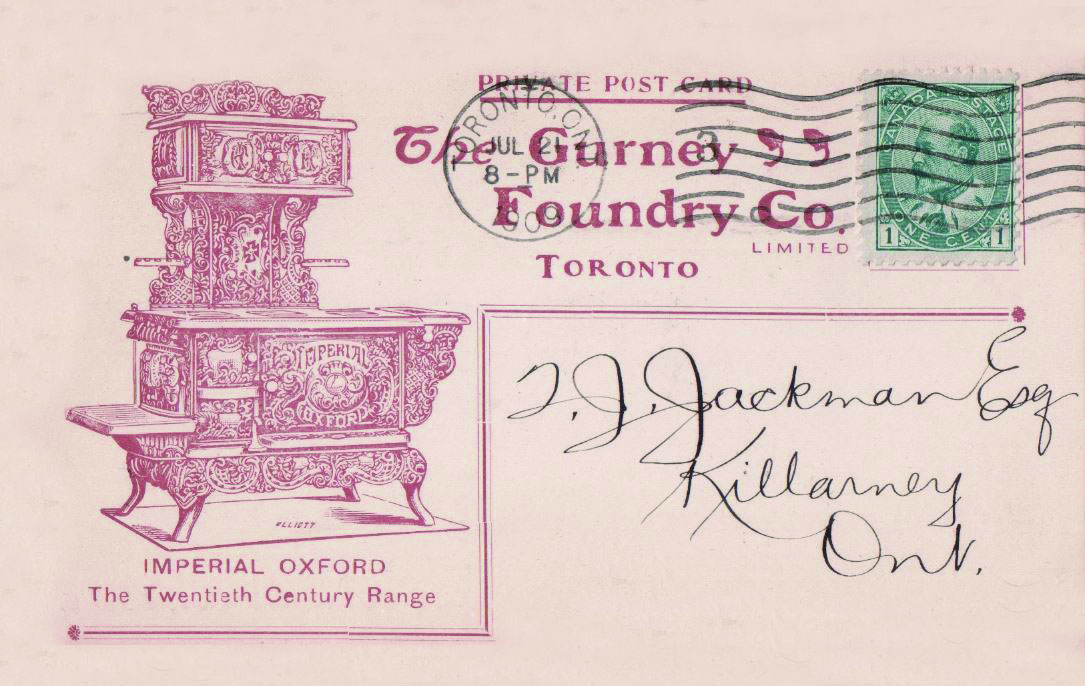
Figure 3. Although mailed in 1909, this terrific Gurney Foundry Co. adverting card, from the Gary Peck collection, was printed prior to 1904.
The pink advertising postcard shown as Figure 4 was published by Toronto’s W. J. Gage & Co. This iconic Canadian printer-publisher started out as a little factory and store in Montréal in 1844. Its founders, brothers Robert and Adam Miller, created the R. & A. Miller partnership to manufacture and sell books and stationery. The firm’s first major success was in the highly competitive school textbook market in 1846. It was also well known for publishing journals for the Legislative Assembly of the Province of Canada. For those who don’t remember their high school history, the Province of Canada was comprised of Canada West (Ontario) and Canada East (Québec) and existed from 1841 until Confederation in 1867.
In 1860, Adam Miller opened a branch of R. & A. Miller in Toronto at 62 King Street East. The brothers’ partnership was subsequently dissolved and in 1871 Adam Miller, now on his own, moved the business to larger premises at 11 Wellington Street West. William J. Gage joined Miller in 1874 and the firm became W. J. Gage & Co. in 1880. By 1884 the stationery and book business had grown so much that W. J. Gage & Co. had to build a new plant on Front Street. This is the plant illustrated on the Figure 4 postcard.
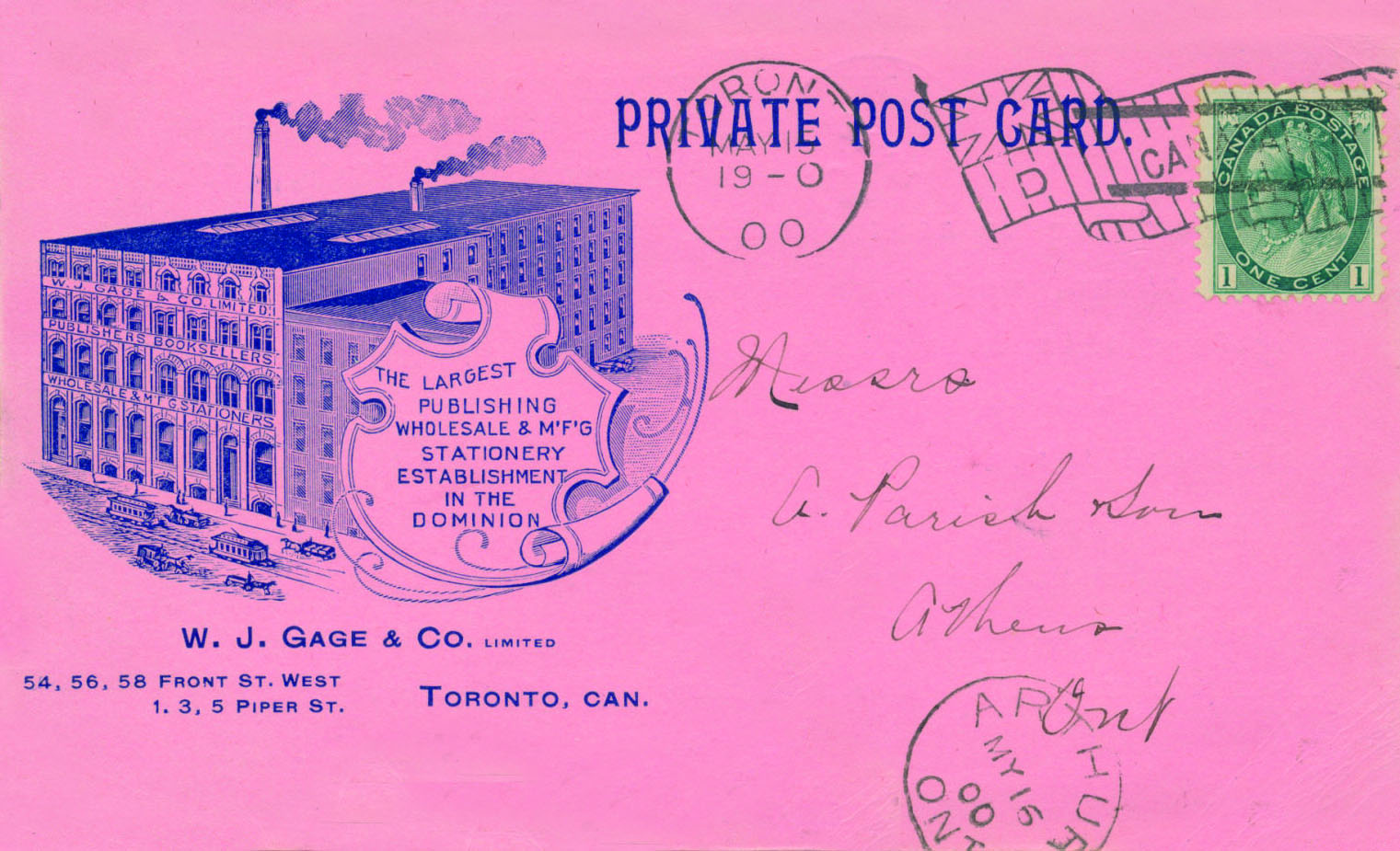
Figure 4. Mailed in 1900 and sporting a Queen Victoria flag cancel, this W. J. Gage & Co. advertising card would be a gem in any collector’s album.