
By Ian Brimble
It is common for most Canadian coin collectors to have coins in their collection from Newfoundland. However, some may be unfamiliar with the history of Newfoundland and how it contributed to the rich numismatic history of our nation. We are fortunate in Canada to have a numismatic history that parallels that of our nation’s history, and as such, the coins of Newfoundland are a product of our national heritage.
Newfoundland, as any good student of Canadian history will tell you, did not join Confederation until 1949, making it the last addition until Nunavut joined Canada in 1999. As such, it has a history that is distinct from the rest of the provinces and territories, and it produced its own coinage from 1865 until the last Newfoundland penny was produced in 1947. It is this history that makes Newfoundland coin collecting such an interesting and unique element of most Canadian coin collectors.
When Newfoundland started producing its coins, the year was 1865 and the production included the penny, 5 cent, 10 cent, 20 cent (later to become the 25 cent) and in 1870, the 50 cent piece. Perhaps the most interesting release of 1865, which was unique to Newfoundland; the 2 dollar gold coin series which ran until 1888. These coins remain highly collectable within the Canadian coin collecting community the world over. It has gained particular appeal lately with the sharp rise in gold prices, at nearly 1/10 ounce, the base metal value of these coins is significant today.
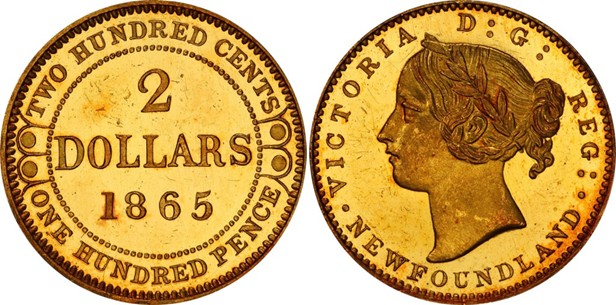
Newfoundland 2 dollar gold coin of 1865In the year 1865, Newfoundland began to produce its own currency (actually starting in 1864 with the penny). Newfoundland had rejected invitations to join Confederation as there was a sizable anti-confederate movement on the island at that time. As such, Newfoundland was working to be as independent as possible, and being a self-governing colony at that time allowed it the opportunity to produce its own currency. However, Newfoundland in the mid 1800s lacked the equipment needed to produce coins and, as such, they had their coins produced in Britain, similar to the Dominion of Canada of the day.
Prior to the first World War, all coins were produced in Britain by the Royal Mint. Coins produced by the Royal Mint in the Newfoundland series can be identified with the absence of a mint mark. (Figure 1)
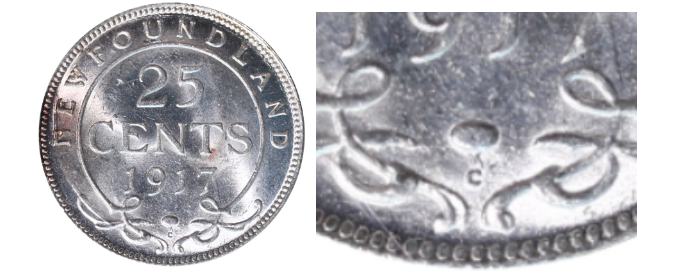
During several years, production was moved from the Royal Mint to the Birmingham Mint which was owned by Ralph Heaton and Sons. Coins produced in the Birmingham Mint have the “H” mint mark. Figure 2 below illustrates the Heaton mint mark below the date. This mark is often found on early Canadian coins produced at the Birmingham Mint as well.
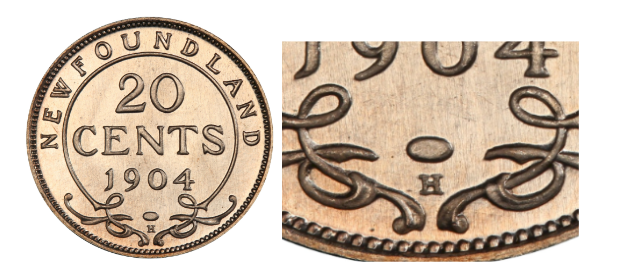
During the first world war, production of coins for Newfoundland was primarily moved to the Royal Canadian Mint in Ottawa. This was done to avoid transiting significant values across the Atlantic at considerable risk during the war years. Coins produced in Ottawa were given the “C” mint mark to denote their production location (See Figure 3). Interestingly, the government of Canada convinced the Newfoundland government to switch the denomination from 20 to 25 cents as Newfoundland coins often circulated within Canada and the similar size and appearance of the 20 cent created confusion.
After the first world war, most production of Newfoundland coins remained the responsibility of the Royal Canadian Mint in Ottawa, with some coins produced in the late 1930s and 1940s remaining with the Royal Mint in London.
Throughout their production, Newfoundland coins have attracted collectors of all types. It is often a challenge to obtain many Newfoundland Victorian coins due to the limited production of these dates when compared to the Canadian production of coins at that time. As an example, in the year 1870, Newfoundland produced 30,000 ten cent coins compared to the Canadian production of 1.6 million that same year. As a result, the collector value of early Newfoundland denominations tends to be higher than their Canadian counterparts. It is this element that makes collection of Newfoundland coins such an appealing undertaking for many collectors as many dates can be elusive rarities, particularly in higher quality examples.
Should you have a Newfoundland coin or collection that you would like to have evaluated, please reach out to set an appointment. Happy collecting!