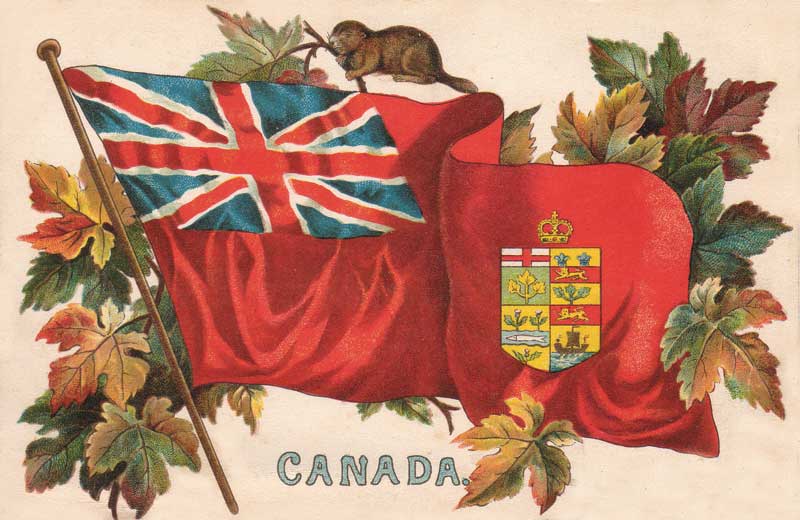
By Mike Smith
In light of the new season, for this issue of the Wayback Times I was thinking about showcasing four antique postcards with fall-coloured maple leaves as the dominant symbol. I knew that finding such cards in my own collection would be fairly straightforward, considering that I’ve specialized in Canadian patriotic postcards for more than four decades now. Andalong with our military and Mounties, the inclusion of maple leaves, beavers and our beautiful coat of arms on antique postcards is what makes them wonderfully patriotic.
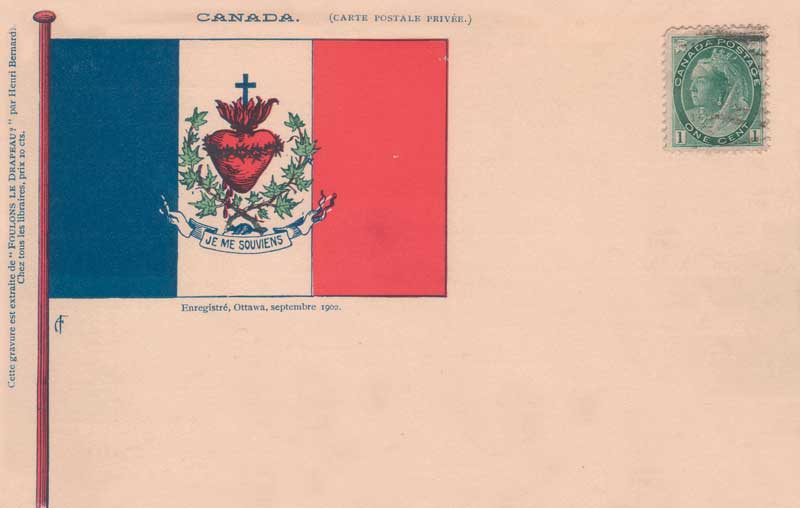
As I flipped through album pages looking for maple leaves, I came across some cards with early Canadian flag designs that I hadn’t looked at in years. For example, one of the more interesting flag designs in circulation at the turn of the 20th century is shown as Figure 1. This classic postcard features a design registered in September 1902 by Henri Bernard. Although a respectable effort by Bernard, the preponderance of Quebec symbols, especially Roman Catholic ones,would have doomed this flag in the national arena. I can just imagine the fury of Ontario’s Orange Order had this design been proposed. “No popery here!” would have bellowed across the province.
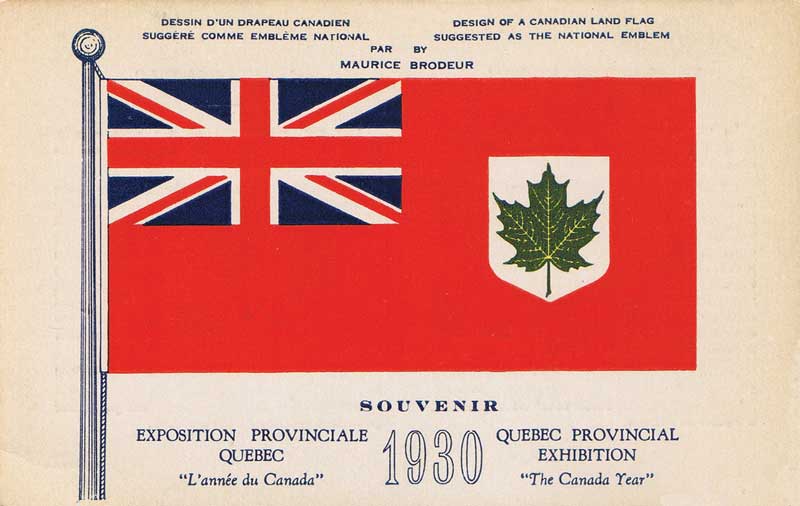
Another flag postcardthat popped up during my maple leaf search is shown as Figure 2. This proposed design by Quebec’s Maurice Brodeur is ona souvenir postcard from the 1930 Quebec Provincial Exhibition. Some of the text on the back describing the design would make today’s Canadians wince, laugh or both. I’ve included it below in bullet form (my comments in brackets):
- The Union Jack represents the allegiance of the Canadians to the British Crown and part taken by the Anglo-Saxons in the conquest of Canada.(Not a clever way of marketing this design in Quebec.)
- The white field of the shield recalls the historical origin of Canada.(What, snow storms?)
- The maple leaf, essentially a national emblem, includes all Canadians.(Essentially? I guess the lowly maple leaf still had a way to go.)
- The red field is emblematic of the sun that ripens our harvests, and of the heat of the earth that creates our industries. (From snow storms to a red-hot sun, yikes!)
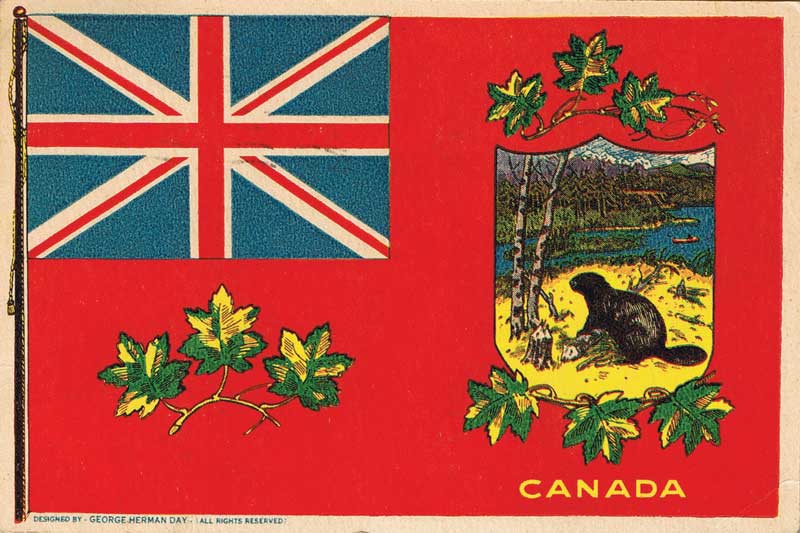
Another 1930s postcard with a Canadian flag proposal is shown in Figure 3. The flag designer here was George Herman Day, who also copyrighted an “O Canada” song and included it on the back of the card. (Thanks to our dithering politicians, our national anthem was actually up for grabs until 1 July 1980, when Robert Stanley Weir’s version was finally proclaimed.) With its nine maple leaves and beaver, Day’s design makes a great patriotic postcard but a confusing flag.
When I first starting collecting patriotic postcardsI was under the impression that the iconic Canadian Red Ensign was our national flag until the Maple Leaf flag was adopted on 15 February 1965. Because of this, I tended to ignore early Canadian postcards with images of Britain’s Union Jack. And when I compiled my first handbook on Canadian patriotic postcards back in 2003, I only catalogued cards with the Union Jack if there were other Canadian patriotic symbols on them. Needless to say, that was one of my many rookie mistakes. When I did eventually learn that the Union Jack was indeed our official national flag until 1965, I began to understand why the majority of the antique postcardsin my collection with Canadian flag proposals originated in Quebec.
Although cherished by many Canadians in the 20th century, especially the soldiers, sailors and airmen who fought under it in the Second World War (1939–1945), the Canadian Red Ensign (see Figure 4) was only our de facto national flag until it was replaced in 1965. (Again, our dithering politicians should have done something about thismany years earlier.) Whether official or not, the Canadian Red Ensign’s long history as anational symbol meant that Prime Minister Lester Pearson had to engage in many raucous debates in Parliament and Royal Canadian Legion Halls over its replacement. It was of course the right thing to do as our Maple Leaf flag is not only beautiful in its simplicity, it’s also one of the most recognizable national flags in the world. Isn’t itgreat when dithering politicians redeem themselves?