
By Ian Brimble
During our last installment we began to explore the 1935 series of banknotes which is an interesting series as it was the first produced by the Bank of Canada shortly after its creation in 1935. These first and only unilingual notes had a very limited run before the introduction of bilingual currency in 1937. Bilingual currency, of course, continues to be the norm for all banknotes produced within Canada to this day. The 1935 series consisted of $1, $2, $5, $10, $20, $25, $50, $100, $500 and $1000 denominations in both English and French; the French series being more rare as between 20% and 30% of each denomination was produced in French and the remaining 70% to 80% were the English issues. The previous article explored the history and production of the $1, $2, $5, and $10 notes. Below we continue our exploration of the series starting with the 1935 $20 note.
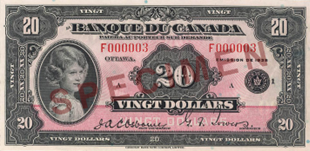
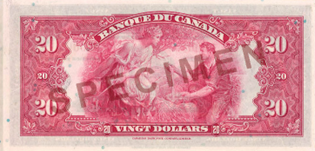
The $20 note pictured above contains the portrait of Princess Elizabeth; the granddaughter of the reigning King George V. She would later go on, (only a short 16 years later), to become Queen Elizabeth II and take the throne herself through a series of events starting with the death of her grandfather King George V in 1936 followed shortly after by her uncle’s abdication and her father’s death at an early age. This note in French and in English is quite rare and carries a high value in average (EF – 40) condition, often between $4000 – $9000. This example is certainly one of the most highly sought after notes for any Canadian banknote collector.
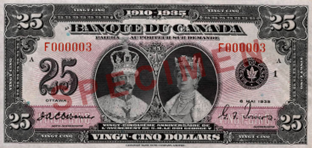
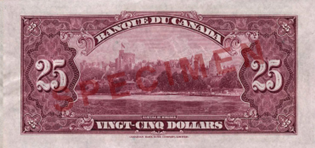
The $25 is also one of the most highly sought after notes in the 1935 series and is a “must have” for many advanced collectors. It is unique in that it is the only $25 dollar note ever produced by the Bank of Canada. It too was produced in an English and French version and it was meant to commemorate the silver Jubilee of King George V. Another unique aspect of this bill is that it contains dual portraits of the then King and Queen Mary. The reverse is a rendition of Windsor Castle. (Approximate EF – 40 value: French – $12,500, English $9000)
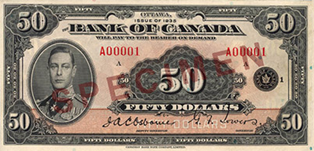
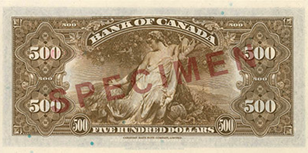
The $50 note in the 1935 series is interesting as it contains the photograph of Prince Albert who, at the time, was the Duke of York. History would later make Prince Albert King George VI after the abdication of his brother discussed above. It is interesting to see the central figure and future King only pictured on the $50 bill given his place in line for the throne in 1935. The 1937 series of banknotes of course would have King George VI prominently displayed as the reigning monarch. This note too is extremely rare and most surviving examples are in less than perfect condition. (Approximate EF – 40 value: French – $12,500, English $7500)
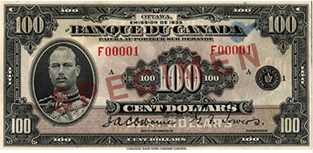
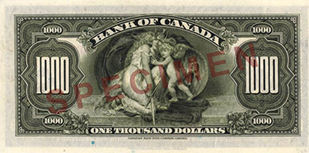
The 1935 $100 note features a portrait of Prince Henry, the Duke of Gloucester. Prince Henry is the third son of King George V and Queen Mary. This note at the time would have had enormous purchasing power; valued around the equivalent today of $2200. This note had approximately 105,000 examples produced with only 17% of those made in French. As a result, the French version in EF – 40 condition has a current value of about $14,000; more than double that of a similar quality English version.
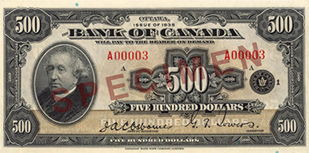
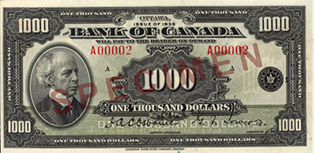
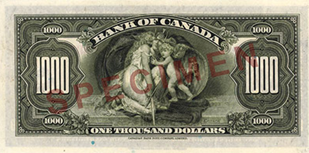
The $500 and $1000 notes produced in 1935 would go on to establish a trend of picturing former Canadian Prime Ministers on our banknotes. Sir John A. MacDonald is pictured on the $500 bill, as Canada’s first Prime Minister and Sir Wilfrid Laurier, Canada’s seventh Prime Minister, was pictured on the $1000 bill. Laurier’s image would go on to take a prominent place on future $5 notes and MacDonald on $10 notes. This established the trend that ultimately led to several other past Prime Ministers being added to our currency. By the 1970s, we had added Mackenzie King to the $50 note and Borden to the $100. Both of the notes pictured above would go on to become exceptional rarities. It is believed that there are no known surviving French $500 notes in existence, but the English version did survive in extremely limited numbers; there are only 12 known! Due to the fact that so few examples remain, the EF – 40 is estimated to be valued in excess of $300,000. The $1000 note fared far better than the $500 in terms of surviving examples but it too remains a significant rarity. (Approximate EF – 40 value: French – $40,000, English $12,000)
This remarkable series is certainly an exceptional collectible as it is unique in the number of Royals pictured throughout the series. It serves not only as a family tree of sorts for King George V, but also as a reminder of the changes to the royal family that were soon to come. They represent a series of banknotes that continues to draw the attention of historians and collectors alike.